
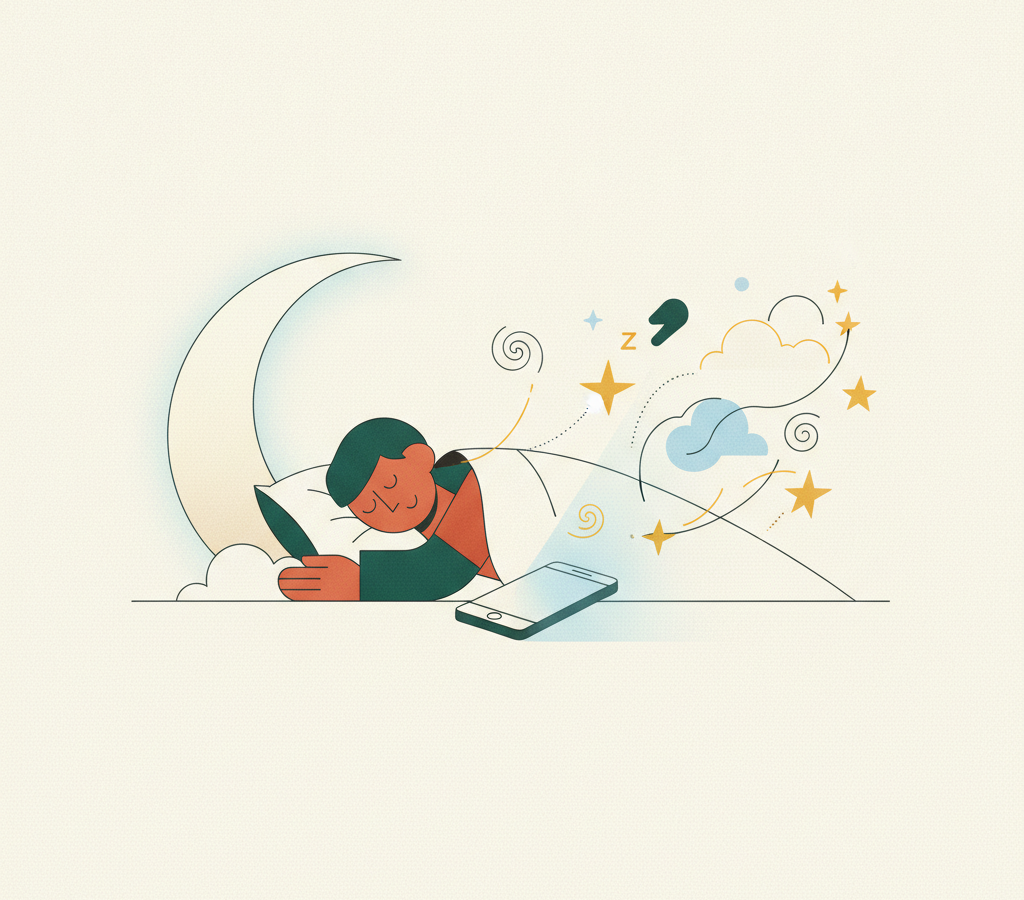
Your phone can hurt your sleep, but mostly because of what you do on it — the mental stimulation and late-night alertness — rather than the blue light everyone blames; the biggest fixes are behavioral, not optical.
If you have ever been told to put your phone away an hour before bed because the blue light will ruin your sleep, you have heard a half-truth. Blue light is a real factor, but it is a supporting actor in a larger story. The research on phones and sleep is nuanced enough that blaming one wavelength of light lets us off the hook for the habits that matter more.
Here is what the evidence actually shows — what is well-established, what is overblown, and what you can reasonably do about it.
Does using your phone before bed actually affect your sleep?
Yes — evening phone use is consistently linked to later sleep onset, shorter sleep, and worse sleep quality, but the strongest driver is mental arousal from the content, not the light from the screen. This distinction is the single most useful thing to understand about phones and sleep, because it changes what you should do about it. If the problem were purely blue light, the solution would be a filter or a pair of glasses. Because the problem is largely what the phone puts in your head, the solution is about the kind of use, the timing, and where the device sits at night.
The research does not say phones are harmless before bed. It says the popular explanation is aimed at the wrong target. Once you separate the light from the behavior, the genuinely effective steps come into focus — and most of them cost nothing.
The blue light story — real, but overstated
Blue-wavelength light (roughly 450–490 nanometers) suppresses melatonin production by signaling to the brain’s suprachiasmatic nucleus — the master circadian clock — that it is still daytime. This is not speculation. Studies dating back to the early 2000s, including work published in The Journal of Clinical Endocrinology and Metabolism, show that bright light in the blue spectrum before bed delays melatonin onset and can shift your circadian rhythm later.
Phone screens do emit blue light. So does overhead LED lighting, laptop monitors, and television. The question the popular headlines rarely ask is: how much melatonin suppression does a typical phone screen actually cause in the hour before bed?
Harvard Health Publishing notes that the screens we typically hold close to our faces produce far less illuminance than the overhead lights in most rooms. If your bedroom lamp is on while you scroll, the lamp is the larger contributor to blue-light exposure. Putting the phone down while leaving the lights blazing misses the point entirely.
What night mode actually does
Apple’s Night Shift and Android’s equivalent modes reduce blue-light output by shifting the display’s color temperature toward yellow-orange tones. In theory this should help. In practice, a 2021 randomized study published in Sleep Health found that iPhone users who used Night Shift did not sleep better than those who did not. The researchers suggested that the behavioral and psychological elements of phone use dwarf the marginal melatonin difference a color-temperature shift produces. Blue-light blocking glasses show similarly mixed results in the literature — some users report benefit, but meta-analyses find the effect size is small and inconsistent.
This does not mean night mode is useless. At the margins, reducing bright blue light is a reasonable step. It just should not be confused with the main problem.
Sleep and training are a loop — recovery is half the argument in the evidence for strength training after 40.
The stronger evidence: arousal, not photons
The more robust signal in the sleep research is psychological and behavioral. A 2015 systematic review in Sleep Medicine Reviews, authored by Lauren Hale and Stanford researcher Sherry Guan, examined dozens of studies on screen time and sleep and found consistent associations between evening screen use and later sleep onset, shorter sleep duration, and worse sleep quality — even after controlling for light exposure.
The mechanism researchers point to is cognitive arousal: phone content activates the brain. Checking email activates problem-solving circuits. Social media comparison activates stress responses. News cycles activate threat-monitoring. A cliffhanger podcast or a heated text thread does not need blue photons to keep you awake — it simply gives your mind something to chew on precisely when you need it to wind down.
The Sleep Foundation describes this as the difference between the device and the content: a phone playing rain sounds in the dark is categorically different from the same phone showing an argument in your group chat at 11 p.m. Both involve a screen. Only one is likely to cost you ninety minutes of sleep.
Notifications as sleep disruptors
Even passive phone presence matters. A study published in PLOS ONE found that the mere buzzing or lighting-up of a phone — even when the owner chose not to check it — was associated with increased errors on cognitive tasks, suggesting a low-grade attentional pull that a phone exerts simply by being present and potentially active. For light sleepers, a notification at 2 a.m. can fragment sleep architecture in ways that affect morning cognitive function, mood, and appetite regulation through disruptions to slow-wave and REM cycles.
Timing matters — and so does individual variation
The NIH’s National Institute of General Medical Sciences notes that circadian sensitivity to light is highest in the two hours before your habitual sleep time and in the first hour after waking. This means the same amount of phone use has different consequences at 9 p.m. versus midnight for someone who typically sleeps at 10:30 p.m. — the earlier window has more biological leverage.
Individual differences are also significant. Evening chronotypes (natural night owls) tend to be more sensitive to evening light exposure because their melatonin onset is already delayed, meaning blue-light effects compound an existing vulnerability. Morning chronotypes may find phone use before bed less disruptive — though they still face the content-arousal problem.
Age matters too. Adolescents and young adults are disproportionately affected, partly because melatonin production is higher and more light-sensitive in younger people, and partly because social media use — with its variable-ratio reward schedules — creates compulsive checking behaviors that are harder to disengage from at bedtime.
If the phone is what you reach for in bed, swapping it for a book is easier with a system — ours is in how to build a reading habit that sticks.
Do blue light glasses work for sleep?
The evidence is weak and inconsistent: some people report benefit, but well-designed trials and reviews find that blue-light-blocking glasses produce small and unreliable effects on sleep, well short of their marketing. This is one of the clearest examples of the blue light myth doing commercial work. Because “blue light ruins sleep” is a tidy story, a product that blocks blue light sounds like a tidy fix. But if the dominant problem is cognitive arousal rather than melatonin suppression from a dim screen, a lens filter cannot address it — you can wear amber glasses and still lie awake replaying a stressful email.
That does not make the glasses harmful, and a subset of users may find them mildly helpful, possibly as a bedtime cue as much as an optical effect. But spending significant money on them while keeping the phone in bed and scrolling a feed until midnight is optimizing the wrong variable. The behavioral steps below have a far stronger evidence base and cost nothing.
How long before bed should you put your phone away?
There is no magic cutoff that fits everyone, but the highest-leverage window is the two hours before your usual bedtime — and what matters most is switching to calm, low-stakes use rather than banning screens outright. The common “no screens one hour before bed” rule is a reasonable rule of thumb, but taken literally it can be both too strict and too lenient. Too strict, because a quiet audiobook or e-reader in a dark room is very different from doomscrolling. Too lenient, because an hour of tense group-chat arguing right up to lights-out can wreck sleep regardless of any filter.
A more useful framing is to protect the wind-down window by changing the type of use, not just the clock. Shift from stimulating, open-ended, reactive activities (social feeds, news, work email) to closed, calming ones (a downloaded book, ambient sound, a short familiar show) as bedtime approaches — and get the phone physically out of reach so the middle-of-the-night notification problem disappears.
What actually works: evidence-based steps
Sleep researchers broadly support the following approaches, grounded in cognitive-behavioral therapy for insomnia (CBT-I), which has the strongest evidence base for improving sleep without medication.
- Stimulus control: Reserve your bed for sleep and sex only. Phones in bed condition the brain to associate the sleep environment with wakefulness and stimulation. Moving phone use — even reading — to a chair or couch creates a cleaner sleep cue.
- Consistent sleep-wake times: A fixed wake time (including weekends) anchors your circadian rhythm more effectively than any single behavioral hack. The Sleep Foundation ranks this as the single highest-yield behavioral intervention for most adults.
- Content, not just duration: A 20-minute limit on social media before bed may be more useful than a blanket one-hour no-screens rule that allows passive video. Ask yourself what you were doing on the phone, not just how long.
- Phone outside the bedroom: If the phone is not within reach, the middle-of-the-night notification problem disappears. An inexpensive alarm clock removes the last practical reason to keep a phone on the nightstand.
- Night mode and brightness reduction: Worth doing as a low-effort marginal measure, but not as a substitute for the steps above.
What you can reasonably set aside
The popular claim that any screen exposure after 8 p.m. categorically harms sleep is not well-supported. For most adults, relaxed, low-stakes phone use — a calm podcast, a quiet novel app, a brief weather check — in the 30 to 60 minutes before bed produces modest, if any, measurable harm compared to someone reading a paper book with a bright lamp on.
Similarly, expensive blue-light-blocking glasses marketed specifically for sleep have not demonstrated consistent benefit over behavioral changes in well-designed trials. The marketing often outruns the evidence here.
A note on what this article is not
This is a summary of research findings, not a clinical recommendation. If you have persistent sleep difficulties — difficulty falling asleep, staying asleep, or waking unrefreshed most nights for more than a few weeks — that is worth discussing with a clinician. Chronic insomnia can have medical contributors (sleep apnea, anxiety, thyroid conditions, medications) that no amount of phone management will fix. CBT-I delivered by a trained therapist or via validated digital programs has strong evidence for chronic insomnia and is often recommended before sleep medications.
The phone-sleep relationship is real. It is just more behavioral and cognitive than photochemical — and that is actually good news, because behavior is something you can change without buying anything.
Frequently asked questions
How does blue light affect sleep?
Blue-wavelength light suppresses melatonin by signaling to the brain’s circadian clock that it is still daytime, which can delay sleep onset. The effect is real but often overstated for phones specifically, because a screen held at arm’s length is usually dimmer than the room’s overhead lighting.
Is the blue light and sleep connection a myth?
Not a myth, but frequently exaggerated. Blue light does influence the circadian system, yet studies controlling for it still find that evening screen use disrupts sleep — pointing to mental stimulation from the content as the larger factor. Calling it “the blue light problem” misses most of what is actually happening.
Do blue light glasses work for sleep?
The evidence is weak and inconsistent. Meta-analyses find small, unreliable effects, and they cannot address the main driver of screen-related sleep loss, which is cognitive arousal. Some people report a modest benefit, but they are not a substitute for behavioral changes.
Does Night Shift or dark mode help you sleep?
Only marginally. A randomized study found iPhone users on Night Shift did not sleep better than those without it. Reducing bright blue light is a reasonable low-effort step, but it should not be confused with the more effective behavioral fixes.
How long before bed should I stop using my phone?
There is no universal cutoff. The most sensitive window is roughly the two hours before your usual bedtime. Rather than a strict ban, shift to calm, low-stakes use — an audiobook or ambient sound instead of social feeds, news, or work email.
Why do notifications disrupt sleep even when I do not check them?
Research suggests the mere buzz or light-up of a phone exerts a low-grade attentional pull, and for light sleepers a nighttime alert can fragment sleep architecture. Keeping the phone out of the bedroom removes the problem entirely.
What is the single most effective change for phone-related sleep problems?
Getting the phone physically out of reach at night, paired with a consistent wake time. These address both the notification problem and the cognitive-arousal problem, and they are supported by the evidence behind cognitive-behavioral therapy for insomnia (CBT-I).
When should I see a doctor about sleep problems?
If you have trouble falling or staying asleep, or wake unrefreshed most nights for more than a few weeks, talk to a clinician. Chronic insomnia can have medical contributors — such as sleep apnea, anxiety, or thyroid conditions — that phone habits alone will not fix. This article is general information, not medical advice.