
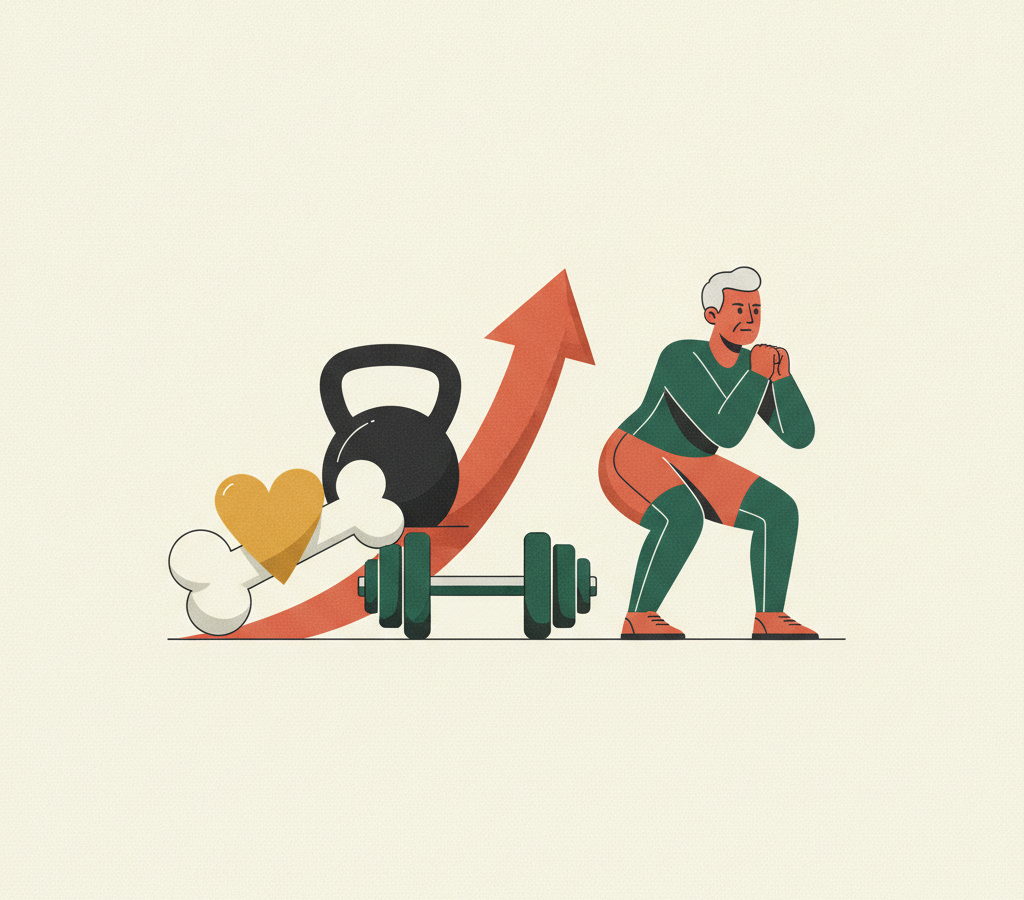
Strength training after 40 is one of the best-supported things you can do for healthy aging: two or more sessions a week working all major muscle groups reliably preserves muscle and bone, improves metabolic health, and lowers fall risk — and it is never too late to start.
Why this matters after 40
Somewhere around the fourth decade of life, a quiet process that started in the late twenties begins to accelerate. Skeletal muscle mass declines at roughly 1–2 percent per year after 50, a process called sarcopenia, and bone mineral density follows a similar trajectory — more steeply in women after menopause. The functional consequences are not abstract. Loss of lower-body strength is one of the strongest predictors of falls among older adults, and falls are a leading cause of injury-related death in people over 65, according to the U.S. Centers for Disease Control and Prevention.
The good news, which is both well-established and underappreciated, is that skeletal muscle responds to resistance training at virtually every age. Studies in adults well into their seventies and eighties document meaningful gains in strength and lean mass from structured programs. The body does not stop adapting; the signal just needs to be delivered.
This article draws on current guidelines and peer-reviewed evidence. It is general health information, not medical advice. Before starting any new exercise program — especially if you have cardiovascular disease, orthopedic injuries, osteoporosis, or other health conditions — talk with your own clinician.
Is it too late to start strength training after 40?
No — the research is unambiguous that adults in their forties, fifties, sixties, and well beyond build measurable strength and muscle from resistance training, so age is a reason to start, not a reason to skip it. The “it’s too late” belief is one of the most common and most costly myths in this space, because it stops people from beginning at exactly the point when the benefits matter most. Sarcopenia and bone loss are gradual, and the trajectory is responsive: introducing a progressive strength stimulus slows and partly reverses the decline rather than merely holding the line.
What changes with age is not whether you can adapt but how you should approach the process. Recovery takes a little longer, connective tissue needs a more gradual on-ramp, and technique deserves more attention. Those are adjustments to method, not disqualifications. The person starting at 55 will progress; they simply progress most safely by respecting the ramp-up rather than training like a 22-year-old.
What the guidelines actually say
The U.S. Department of Health and Human Services Physical Activity Guidelines for Americans, now in their second edition, set the clearest quantitative bar for the general adult population: at least 150 to 300 minutes per week of moderate-intensity aerobic activity, plus muscle-strengthening activities involving all major muscle groups on two or more days per week. The World Health Organization’s 2020 global recommendations for physical activity and sedentary behaviour align closely with this framework for adults aged 18–64, and explicitly extend it to adults 65 and older, adding balance and coordination exercises to reduce fall risk.
Two days per week is the evidence-based floor, not a ceiling. Research suggests that two sessions targeting the major muscle groups — legs, hips, back, abdomen, chest, shoulders, arms — produce meaningful adaptations in strength and muscle mass. Three sessions per week show somewhat larger effects in most studies, but the marginal returns diminish after that for general health purposes, and recovery becomes a more active concern.
What counts as a muscle-strengthening activity? The guidelines include free weights, resistance machines, resistance bands, bodyweight exercises such as push-ups and squats, and activities like heavy gardening or carrying loads. The common thread is that muscles work against an external resistance that challenges them — not merely moving through a comfortable range of motion.
The established benefits: what the evidence actually shows
It is worth being precise about what is well-supported and what is more tentative, because the fitness and supplement industries routinely conflate the two.
Muscle mass and strength
The evidence that resistance training preserves and builds skeletal muscle in adults over 40 is among the most robust in exercise science. Meta-analyses consistently show statistically significant gains in muscle cross-sectional area and maximal strength in older adults following progressive resistance programs lasting eight weeks or more. Effect sizes are smaller than in younger adults but clinically meaningful.
Bone density
The National Institutes of Health notes that weight-bearing and resistance exercise stimulate bone remodeling and can slow bone mineral density loss. The evidence is strongest for the hip and spine — the sites of most consequential fractures. High-impact loading and heavy resistance work appear more effective than light resistance for bone stimulus, though the optimal prescription for bone specifically is still an active area of research.
Metabolic health
Skeletal muscle is the body’s largest site of insulin-mediated glucose disposal. Greater muscle mass is associated with better insulin sensitivity, and resistance training independently improves glycemic control in people with and without type 2 diabetes — an effect documented in clinical trials and reflected in exercise guidance from diabetes organizations. The mechanism here is reasonably well understood: muscle contractions increase glucose uptake through pathways that bypass insulin resistance.
Training buys you healthspan; catching problems early buys you time to use it — pair this with the screenings worth your time.
Functional health and fall prevention
Lower-body strength — the ability to stand from a chair, climb stairs, and recover from a stumble — is a strong predictor of independence in older adults. The CDC’s STEADI (Stopping Elderly Accidents, Deaths, and Injuries) initiative and supporting literature highlight balance training and strength work as components with evidence behind fall prevention. The effect size for exercise-based fall prevention programs is meaningful, though results depend heavily on program design and adherence.
Mental health and cognitive function
The evidence base here is genuine but less settled than for the physical outcomes above. Multiple randomized trials and meta-analyses show resistance training associated with reductions in depressive symptoms and improvements in some cognitive domains, particularly executive function, in older adults. The mechanisms proposed — including reduced neuroinflammation, improved cerebrovascular function, and neurotrophic factor expression — are biologically plausible. But effect sizes vary, confounders are difficult to fully eliminate, and this literature is still maturing. It is a reason to be optimistic, not a certainty.
Does strength training after 40 differ for women?
The core principles are the same for women and men, but the case for strength training is arguably stronger for women, who lose bone density more rapidly around menopause and face higher lifetime fracture risk. Resistance training is one of the few non-pharmaceutical interventions that directly loads bone at the hip and spine, the sites where fractures are most consequential later in life. For women over 50 in particular, that makes it less an aesthetic pursuit than a long-term investment in skeletal and functional independence.
A persistent worry — that lifting will make women “bulky” — is not supported by the physiology. Building large amounts of muscle mass is slow and difficult, and the typical result of a sensible program is greater strength, better bone health, and improved body composition rather than dramatic size. Hormonal changes through perimenopause and menopause do shift how the body responds, which is a reason to prioritize progressive resistance and adequate protein, not a reason to avoid the gym. As with any new program, women with osteoporosis or other conditions should tailor the approach with a clinician.
How to start safely after 40
The principles are straightforward, though following them requires patience that the fitness industry rarely encourages.
Start lighter and longer than you think necessary. The most common injury pattern in adults returning to resistance training after years away is not catastrophic — it is tendinopathy from load introduced too quickly. Tendons and connective tissue adapt more slowly than muscle. A conservative first four to six weeks builds neuromuscular coordination and tissue tolerance before loading aggressively.
Prioritize compound movements. Exercises that train multiple joints — the squat, the hinge (deadlift pattern), the press, the row — deliver more stimulus per unit of time and train the movement patterns most relevant to everyday function. They also allow relatively easy progressive overload, which is the core driver of adaptation.
Progressive overload is the mechanism. The principle that muscles must be challenged progressively — by increasing weight, repetitions, sets, or reducing rest — is the closest thing strength training has to a universal rule. A program that does not change over time does not produce continuing adaptation. This does not require extreme weight; it requires consistent, gradual challenge.
Recovery matters more, not less, after 40. Sleep, protein intake, and rest days between sessions targeting the same muscle groups are not optional recovery hacks — they are where adaptation actually happens. Most exercise physiologists recommend 48–72 hours between sessions stressing the same muscle groups. Sleep deprivation measurably impairs both performance and recovery, an effect documented in controlled studies.
Seek qualified instruction for technique. Poor technique under load is where injuries happen. A session or two with a certified strength and conditioning coach or physical therapist is more valuable than months of program-hopping. This is especially true for complex loaded patterns like barbell squats and deadlifts.
Can you do strength training at home without equipment?
Yes — bodyweight movements, resistance bands, and a few adjustable dumbbells are enough to meet the guidelines and build meaningful strength, provided you keep progressively challenging the muscles. The guidelines define muscle-strengthening activity by the demand placed on the muscle, not by the equipment used. Push-ups, squats, lunges, step-ups, hip hinges, and rows with bands all qualify, and for a beginner returning after time away they often provide plenty of stimulus for the first several weeks.
The practical limitation of a home, no-equipment setup is progression. Because progressive overload drives adaptation, you eventually need a way to keep increasing the challenge — harder variations, more range of motion, slower tempo, heavier bands, or a modest set of adjustable dumbbells or a kettlebell. Many people do well starting at home to build the habit and basic competence, then adding minimal equipment as bodyweight exercises become easy. A gym is convenient for loading heavy compound lifts, but it is not a prerequisite for getting stronger.
What to ignore
The wellness market around strength training for midlife adults is dense with overclaimed products and programs. A few recurring patterns worth recognizing:
Testosterone boosters and “natural anabolics.” The vast majority of over-the-counter supplements marketed as testosterone support have no credible clinical trial evidence for meaningful effects on muscle mass or strength in healthy adults. The FTC has acted against numerous such products. If you suspect clinically low testosterone, that is a conversation for your physician, who can run a blood test — not a supplement aisle decision.
Progress is made in recovery as much as in the gym, which is why the phone-and-sleep evidence belongs in any training plan.
“Anti-aging” protocols that promise hormetic specificity. Claims that specific rep ranges, specific workout times, or specific nutritional windows unlock unique age-reversing mechanisms are, with few exceptions, extrapolations from basic science that has not been tested in humans at the claimed precision. The fundamentals — consistent progressive resistance training, adequate protein, adequate sleep — account for most of the obtainable benefit.
High-intensity programs marketed specifically to older adults. Some are well-designed. Many are not. The distinguishing feature of a credible program is whether it builds in progression and accounts for recovery, not whether it is maximally intense from week one.
The “it’s too late” narrative. This one is worth naming because it discourages people from starting. The evidence is clear that meaningful gains in strength, muscle mass, and functional capacity are achievable in people in their fifties, sixties, seventies, and beyond. “Too late” is not supported by the literature.
A note on protein
Dietary protein is not a supplement category but a genuine variable in muscle protein synthesis. The current evidence suggests that adults over 50 benefit from somewhat higher protein intakes than younger adults to achieve equivalent rates of muscle protein synthesis — a phenomenon called anabolic resistance. Common evidence-based estimates for active older adults range from 1.2 to 1.6 grams of protein per kilogram of body weight per day, distributed across meals rather than concentrated in one. This is an area of active research, and the numbers vary by source and study design. A registered dietitian can help translate this into practical eating patterns.
The bottom line
The evidence for resistance training as a pillar of healthy aging is not marginal or preliminary — it is among the more durable findings in exercise science. Two or more days per week of muscle-strengthening activity involving all major muscle groups is the current evidence-based recommendation from major health authorities. The benefits for muscle mass, bone density, metabolic health, and fall prevention are well-documented. Starting conservatively, progressing gradually, and recovering adequately are the principles that make those benefits accessible without injury.
The marketing around this space is noisier than the science. The science is actually fairly straightforward, and the barrier to entry is lower than it is often portrayed.
Frequently asked questions
Is it too late to start strength training after 40 or 50?
No. Studies in adults well into their seventies and eighties show meaningful gains in strength and muscle mass from structured resistance programs. Age changes how you should approach training — a more gradual ramp-up and more attention to recovery — but it does not remove the ability to adapt.
How many days a week should I strength train?
Major guidelines recommend muscle-strengthening activity working all major muscle groups on two or more days per week. Two sessions is the evidence-based floor; three tends to produce somewhat larger effects, with diminishing returns and greater recovery demands beyond that for general health.
What are the main benefits of strength training after 40?
The best-supported benefits are preserved and increased muscle mass and strength, slower bone density loss, better insulin sensitivity and glycemic control, and reduced fall risk through improved lower-body strength and balance. Benefits for mood and some cognitive domains are promising but less settled.
Is strength training different for women over 40?
The principles are the same, but the case is arguably stronger for women, who lose bone density faster around menopause. Resistance training directly loads bone at the hip and spine. The fear of becoming “bulky” is not supported by the physiology; the typical result is greater strength and better bone health.
Can I build strength at home without a gym?
Yes. Bodyweight exercises, resistance bands, and a few adjustable dumbbells or a kettlebell can meet the guidelines and build real strength. The main limitation is progression, so plan to increase the challenge over time through harder variations, tempo, or added load.
How much protein do I need for strength training after 40?
Evidence suggests adults over 50 benefit from somewhat higher protein intakes than younger adults — commonly cited estimates for active older adults range from about 1.2 to 1.6 grams per kilogram of body weight per day, spread across meals. This is an active research area, and a registered dietitian can personalize it.
Do testosterone boosters or “natural anabolics” help?
For healthy adults, the vast majority of over-the-counter testosterone-support supplements have no credible evidence for meaningful gains in muscle or strength, and the FTC has acted against many such products. If you suspect clinically low testosterone, that is a conversation for your physician, not a supplement purchase.
How do I avoid injury when starting after 40?
Start lighter and progress more slowly than feels necessary, since tendons and connective tissue adapt more slowly than muscle. Prioritize compound movements, allow 48–72 hours between sessions targeting the same muscles, prioritize sleep, and consider a session or two with a qualified coach to check technique. This article is general information, not medical advice — consult your clinician before starting if you have existing conditions.
For more on how we assess the evidence we report on, see our methodology page. You can also get our weekly wellness coverage by subscribing to the Fullimedia newsletter.
This article is general health information only and does not constitute medical advice. Consult your own clinician before starting a new exercise program, especially if you have existing health conditions.