
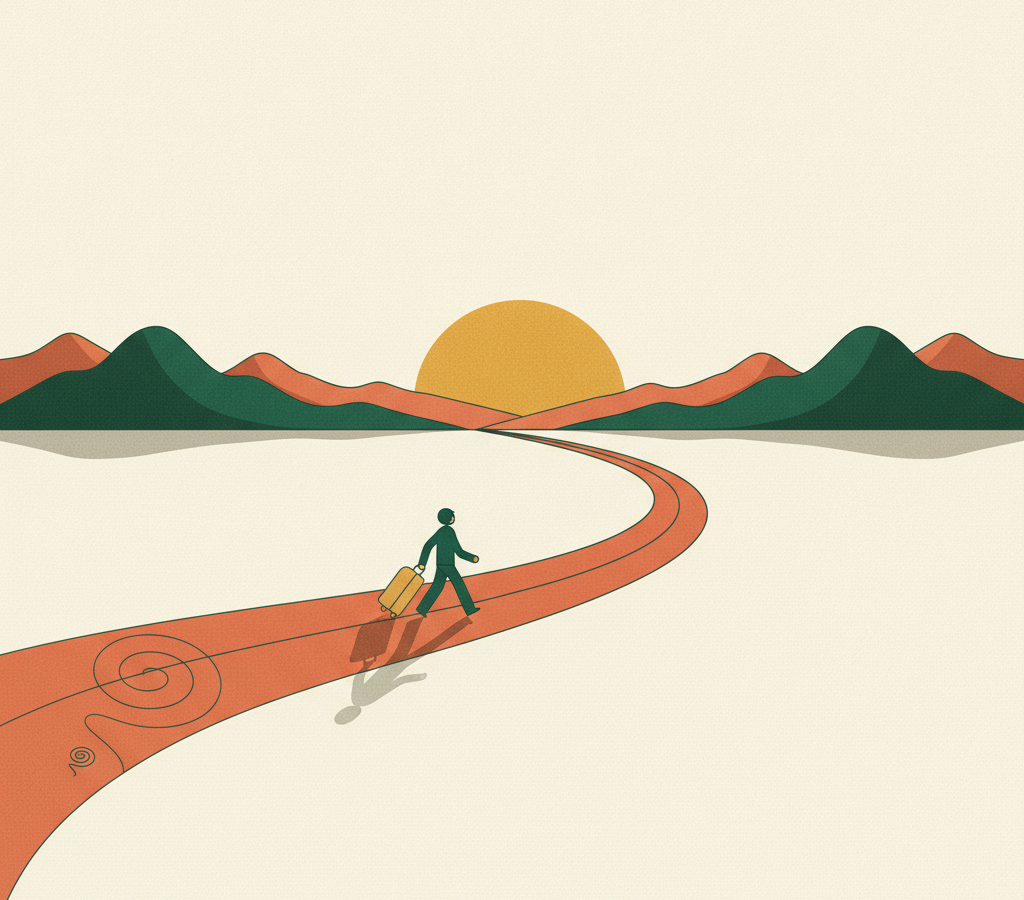
Slow travel means staying in fewer places for longer instead of racing through a checklist of destinations. It trades breadth for depth — one city for two weeks rather than five cities in eight days — and it is usually cheaper, lower in carbon emissions, and more memorable than fast, sight-ticking tourism.
There is a particular kind of exhaustion that follows a certain style of vacation — the one where you return home needing another holiday to recover. You have the photographs: the Colosseum at noon, the Eiffel Tower at dusk, the canal in Bruges framed between your outstretched arms. You have the stamp in the passport. What you may not have, upon honest reflection, is much sense of having been anywhere. The places passed through you rather than the reverse.
This is not a complaint about travel itself, which remains one of the most reliably enlarging things a person can do. It is an observation about a particular approach to travel — the itinerary as spreadsheet, the city as checklist — that has become so dominant it can feel like the only option. It is not. And the alternative, which goes by the ungainly name of “slow travel,” turns out to be more accessible, more affordable, and more interesting than its reputation as a luxury or a lifestyle brand suggests.
What is slow travel?
Slow travel is an approach to travel that prioritizes staying longer in fewer places, connecting with local life, and moving at a pace that allows genuine experience rather than maximum coverage. It is not a specific product you buy or a minimum number of weeks you must commit; it is a set of choices about how to allocate the time you have. A slow traveler picks one city or region as an anchor, settles in long enough to learn its rhythm, and lets unplanned hours do some of the work that a packed itinerary crowds out.
The phrase can summon images of a writer renting a Tuscan farmhouse for a season, which is a fine thing to do but not a useful definition. More practically, slow travel means staying in fewer places for longer — trading the breadth of a five-city loop for the depth of two weeks in one city, or three weeks in one region. It means choosing accommodation that has a kitchen or a neighborhood market nearby. It means having a regular coffee place by the third day, knowing which street the good bakery is on, recognizing the rhythm of the neighborhood.
Slow travel changes how you eat, too — mostly by walking past the places we describe in why “authentic” restaurants are a marketing idea.
This is less a philosophy than a set of practical decisions about how to allocate time. The shift it produces is not mystical. It is simply that when you have more days in a place than you have things on a list, you start wandering without an agenda. You end up at a neighborhood football match not because it was on the itinerary but because you walked past a pitch on a Saturday afternoon. You have a long conversation with the owner of a small shop because you were not in a hurry to catch the next train. These are the experiences that survive in memory, and they are not available to the traveler passing through on a 48-hour window.
The travel writer Pico Iyer, who has written extensively about stillness and attention as prerequisites for genuine encounter, frames it this way: the quality of what you receive from a place is largely a function of what you bring to it — primarily time and openness. Speed forecloses both. You cannot be open to the unexpected when you are managing an optimized schedule.
What Checklist Tourism Actually Costs
The five-cities-in-eight-days itinerary is not irrational. Flights are expensive, time off is scarce, and the world is large. The logic of maximizing coverage per trip makes sense on a spreadsheet. The problem is that the experience does not unfold on a spreadsheet.
Consider what the mathematics of checklist tourism actually produces. Arrive in a city mid-afternoon after a flight. Navigate to the hotel, which is chosen for its proximity to attractions rather than any neighborhood character. Spend two days absorbing the headline sights — which are headline sights precisely because they attract millions of people simultaneously, creating an experience that is as much about crowd management as cultural encounter. Move on. The memory you carry is less a place than a surface: the famous facade, the menu in the tourist-district restaurant, the queue.
UN Tourism (formerly UNWTO) data has documented the downstream effects of this pattern at scale. Overtourism — a term the organization began using systematically around 2017 — describes what happens when visitor volume in a specific location overwhelms the infrastructure, ecology, or social fabric of the place. Venice has spent years attempting to manage day-trippers who arrive, photograph, eat, and leave without meaningfully contributing to the local economy. Barcelona, Dubrovnik, and Kyoto have each implemented or debated visitor caps and entry fees. The checklist tourist is not morally blameworthy for these dynamics — systems create behaviors — but the aggregate effect of millions of people optimizing for maximum destinations visited is now a recognized policy problem.
For the individual traveler, the costs are more personal: the paradox of returning from a “vacation” more depleted than rested, and the nagging sense that you were present for a place without actually being in it.
What are the benefits of slow travel?
The main benefits of slow travel are lower costs, a smaller carbon footprint, deeper cultural connection, and more restful, memorable trips. Each of these follows from the same structural choice — fewer places, more time — and they reinforce one another. Because you fly less often and stay in one apartment rather than cycling through hotels, you spend less money and generate fewer emissions. Because you are in a neighborhood long enough to find where locals actually eat and shop, more of your money reaches the local economy rather than transit hubs and tourist-district chains.
The environmental case is worth stating plainly. Aviation accounts for roughly 2.5 percent of global CO2 emissions directly, but when non-CO2 warming effects at altitude are included, the contribution to climate forcing is estimated to be two to four times higher. The dominant variable in any trip’s footprint is not how you get around once you arrive — it is how many times you fly. A traveler who takes two long-haul flights a year and spends three weeks per destination generates a meaningfully smaller aviation footprint than one who takes six short trips requiring a flight each way. The slow traveler is not necessarily choosing deprivation; they may be choosing the same total time abroad, just distributed differently.
The human benefit is harder to quantify but is the one most travelers notice. Encounter requires friction, and friction requires time. Reuters and other travel-industry reporters have noted a growing segment of travelers — particularly among younger, urban demographics — who are actively choosing overland routes and extended stays partly for environmental reasons and partly because they have found the experience more satisfying. The slow-travel argument, in other words, does not require an appeal to sacrifice.
How do you start slow travel on a normal vacation?
You can practice slow travel on a standard two-week vacation by choosing one anchor destination, staying in a local apartment, and building in unscheduled time rather than trying to see everything. Slow travel does not require a sabbatical or six weeks off. A ten-day trip to a single city or region — rather than five cities — is already a form of it, and most of the depth is available at that modest scale. The adjustment is not about having more time overall; it is about spending the time you have in fewer places.
A few practical slow travel tips make the shift concrete:
- Choose one anchor city and explore its surrounds by day trips rather than moving hotels every two nights.
- Stay in apartments or locally owned guesthouses rather than hotel chains; the kitchen access alone changes how you interact with markets and neighborhoods.
- Build one genuinely unscheduled day into every trip — no booked tickets, no queue, no landmark — and notice what you find.
- If you are traveling with a partner or family, negotiate one “list” destination and one “lingering” destination per trip.
Long train rides are also how several of us finally fixed our reading lives — method in building a reading habit that sticks.
On money: slow travel is frequently cheaper, not more expensive. Airport hotels, tourist-district restaurants, and rapid-fire entrance fees to major attractions add up quickly. An apartment rental for a week often costs less per night than a central hotel, and eating where locals eat — which requires being in a neighborhood long enough to find those places — is cheaper than eating where tourists are directed. The extended-stay model trades the premium of convenience for the savings of familiarity.
What makes a good slow travel destination?
A good slow travel destination is one you can settle into from a single base — with walkable neighborhoods, everyday amenities like markets and cafes, and enough surrounding area to explore by day trip rather than by relocating. The specific country matters less than the shape of the stay. A mid-sized city with a distinct local life and good regional transport will almost always reward a slow traveler more than a famous capital experienced through its most crowded landmarks. What you are looking for is a place dense enough with ordinary life that two weeks reveals texture a weekend never could.
This is why slow travel works as well in an unglamorous regional town as in a bucket-list city. A neighborhood with a bakery, a market, a park, and a bus line to nearby villages gives you the raw material for the kind of unstructured days that produce lasting memories. Culture-focused itineraries — a single region explored slowly for its food, music, or daily rhythms — tend to satisfy far more than a rapid loop of headline sights. When choosing, favor depth of everyday life over the number of monuments a place is famous for; the monuments will still be there, but so will everything around them that most visitors never slow down enough to notice.
The Human Return
The deepest argument for slow travel is not about sustainability or savings. It is about what travel is for.
If the goal is to accumulate proof of having been somewhere — photographs that signal “I was here,” passport stamps as trophies — then the efficient-itinerary model delivers. If the goal is something more like encounter — with a place, with other people, with versions of daily life that are meaningfully different from your own — then it requires a different mode.
Encounter requires friction, and friction requires time. The pleasures of slow travel are largely the pleasures of being slightly lost, slightly uncertain, and therefore slightly more awake. The local who gives you directions because you are clearly confused. The afternoon that goes nowhere in particular. The realization, on the fourth or fifth day, that you have developed a small mental map of a neighborhood and it feels, however temporarily, like somewhere you have actually lived.
These are not experiences you can buy or book. They are experiences that happen when you stop optimizing and start paying attention. The world is large and life is short, and there is real loss in never getting to Rio or Nairobi or Kyoto. But there is also a particular loss — quieter, harder to name — in having technically been to all three without having been anywhere at all. The case for slowing down is ultimately a case for the kind of travel that stays with you, rather than the kind you merely survive.
Frequently asked questions
What is slow travel in simple terms?
Slow travel is staying in fewer places for longer and connecting with local life rather than rushing through a checklist of sights. It prioritizes depth of experience over the number of destinations covered.
Is slow travel more expensive than regular travel?
Usually it is cheaper. Weekly apartment rentals often cost less per night than central hotels, eating where locals eat is cheaper than tourist-district dining, and fewer flights and transfers mean lower transport costs.
How long does a trip need to be to count as slow travel?
There is no fixed minimum. A ten-day stay in one city or region rather than five cities already qualifies. The point is spending more days in fewer places, whatever total time you have.
What are the benefits of slow travel?
Lower costs, a smaller carbon footprint, deeper cultural connection, more money reaching local economies, and more restful, memorable trips. These follow from flying less and staying put longer.
Is slow travel better for the environment?
Yes, primarily because it involves fewer flights. Aviation is the dominant variable in a trip’s carbon footprint, so taking fewer, longer trips generates meaningfully lower emissions than many short ones.
How do I start slow travel if I only have two weeks off?
Pick one anchor destination, stay in a local apartment, explore surrounding areas by day trip instead of relocating, and leave at least one day completely unscheduled. Most of the depth of slow travel is available within a normal vacation.
What are the best destinations for slow travel?
Any place with walkable neighborhoods, local markets, and enough surrounding area for day trips works well. Rather than a specific list, look for a region you can settle into for one to three weeks and explore from a single base.