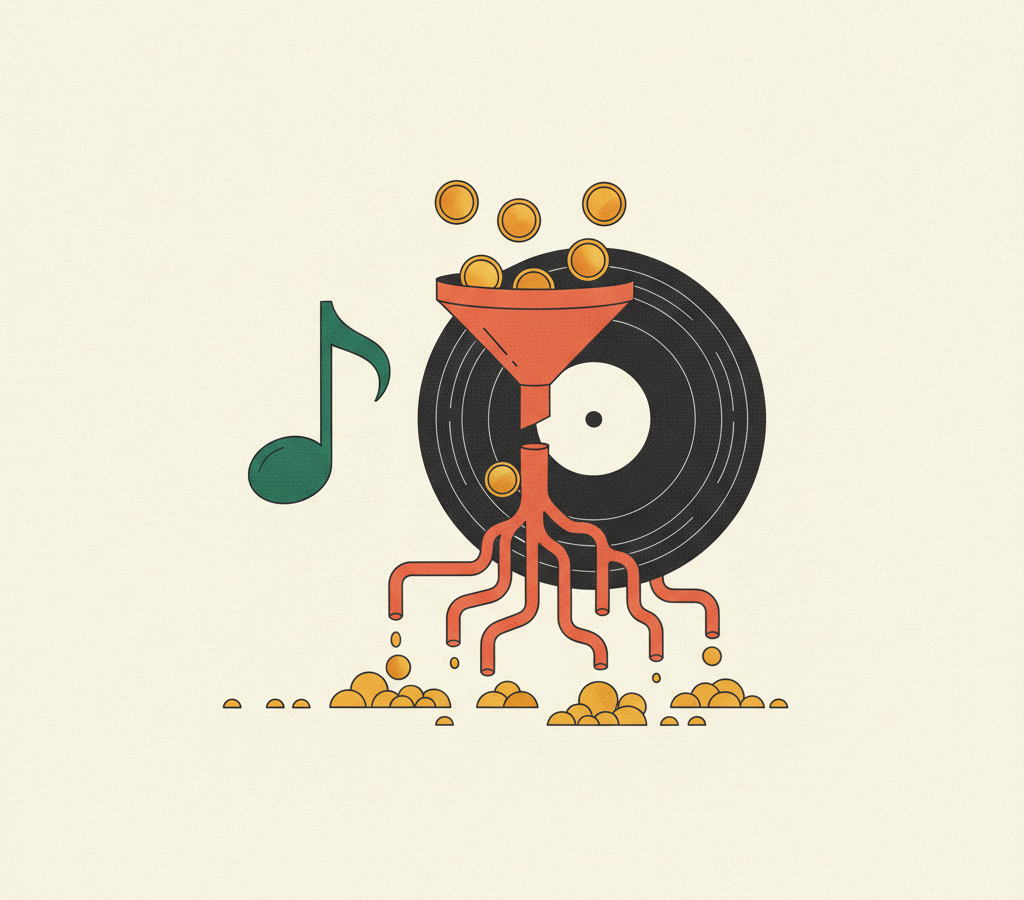
Musicians make money from several stacked sources: streaming royalties, publishing and performance royalties, live touring, sync licensing, and direct sales of physical formats and merchandise. Streaming pays only a fraction of a cent per play, so for most working artists touring and sync — not streaming — are the primary income.
Sometime in the past decade, music became functionally free — a limitless tap of catalogues, algorithmically shuffled, always open. For listeners, this was an uncomplicated improvement. For the people who make music for a living, the transition rewired every financial relationship in the industry in ways that still aren’t fully settled. The numbers are large in aggregate and brutal in the detail.
The IFPI’s Global Music Report 2025 records recorded-music revenues at $28.6 billion for 2024, up roughly 10 percent year-on-year and led by streaming. That headline figure is real and meaningful. What it obscures is the distance between money entering the ecosystem and money reaching an artist’s bank account. To close that gap, you need to follow the cash.
How do musicians make money in 2026?
Musicians make money by combining income from streaming royalties, publishing and performance royalties, live touring, sync licensing, and direct-to-fan sales — because no single source pays most artists a living wage on its own. The modern music income is a stack, not a paycheck. A track streaming online triggers royalties on two separate rights at once; the same song can later be licensed to a TV show, pressed to vinyl, performed on tour, and sold as merchandise. Each layer pays differently, on a different schedule, and to a different set of rights holders.
Understanding how musicians make money means understanding that the size of each layer depends almost entirely on the contracts behind it. An artist who owns their master recordings and publishing keeps far more of every dollar than one signed to a traditional label and publisher deal. The rest of this piece follows the cash through each layer, starting with the one listeners think about most — streaming — and ending with the ones that actually pay the bills for most working artists.
The Per-Stream Rate — and Why the Math Is Harder Than It Looks
There is no single, fixed per-stream rate on Spotify or Apple Music. Both services operate on what the industry calls a pro-rata pool model: each month, a platform takes its total royalty payout pool — determined by subscriber counts and ad revenue — and divides it proportionally based on share of total streams. In practical terms, a stream of a Taylor Swift single and a stream of an independent Nairobi jazz musician both draw from the same pot, but Swift’s track claims a vastly larger share of it.
The effective per-stream blended rate on major platforms has hovered between $0.003 and $0.005 for several years, according to Luminate industry data and independent label estimates compiled by Billboard. Run that arithmetic: a song that racks up 10 million streams — a legitimate mid-tier success by any reasonable measure — generates somewhere between $30,000 and $50,000 in total streaming royalties before any splits occur. That is a gross figure. The splits are where things get complicated.
Pro-Rata vs. User-Centric: A Live Debate
Critics of the pro-rata model — a coalition that includes independent artists, songwriter advocates, and some industry economists — have argued for years that it structurally advantages major-label superstars at the expense of everyone else. The proposed alternative, user-centric payment, would allocate each subscriber’s monthly fee only to the artists that subscriber actually listened to, rather than pooling all money against all streams. SoundCloud and Deezer have run variants of it. Tidal has experimented with a modified version called the artist-centric model. Spotify announced its own version of artist-centric payouts in 2023, setting a minimum stream threshold before tracks qualify for royalties. The jury is still out on net distributional impact, and the debate has real stakes for anyone outside the commercial mainstream.
How much money do musicians make from streaming on Spotify?
Musicians typically make between $0.003 and $0.005 per stream on Spotify, and that gross amount is then split with labels and publishers, so the artist’s actual take is usually a fraction of a cent per play. At that rate, one million streams generates roughly $3,000 to $5,000 in total royalties before any deductions — and an artist on a traditional label deal may see only 12 to 25 percent of the master-side portion of that. This is why streaming income becomes meaningful only at very large volumes, in the tens or hundreds of millions of plays.
The reason the per-stream figure feels so small is the pro-rata pool model: your share of the monthly payout is your share of total streams platform-wide, and the platform-wide total is dominated by a handful of superstars. An independent artist who owns their recordings and distributes through a service that passes through most of the royalty will keep far more of each stream than a newly signed act still recouping an advance — who may receive nothing from streaming until the label has recovered its costs. The headline “per-stream rate,” in other words, is only the starting point; deal structure determines what actually lands in the artist’s account.
The Label Split: The Number Most People Don’t Know
When a streaming platform pays out a royalty for a master recording, it sends that money to whoever owns or controls the master. Under a traditional record deal, that is the label — not the artist. The artist receives a contractually specified royalty rate, typically expressed as a percentage of the label’s net receipts. For established acts, this might be 20–25 percent. For new signings, the RIAA’s historical data and industry legal filings suggest it often falls between 12 and 18 percent of net, with additional deductions for packaging (a legacy clause that survives digitally in some older contracts), producer points, and unrecouped advances.
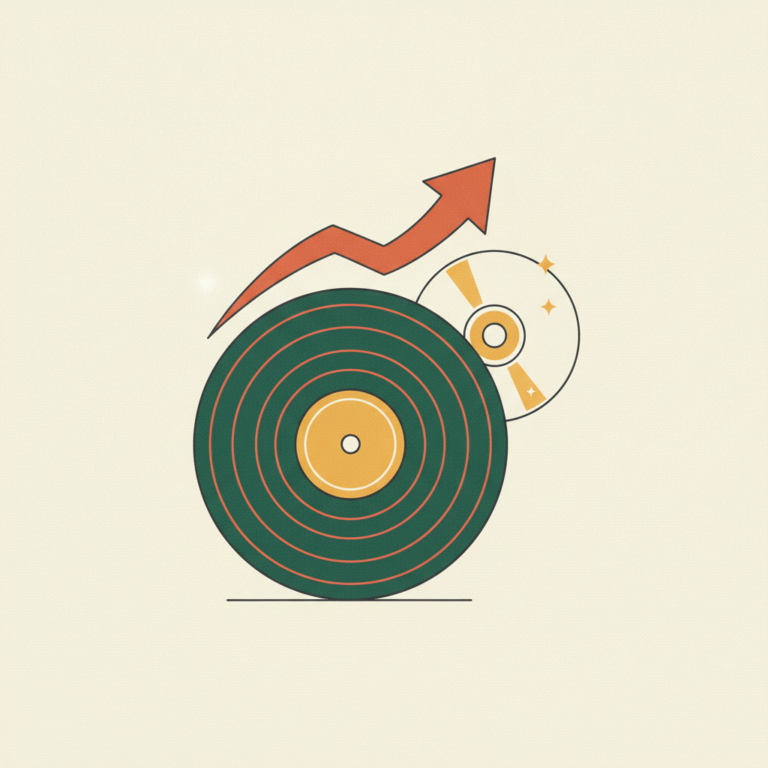
The format story runs in parallel — vinyl outselling CDs says as much about fan economics as any royalty statement.
Translation: of that $30,000–$50,000 generated by 10 million streams, a label typically retains 80–85 percent against the master. An artist on a 15-percent royalty deal with an outstanding advance — essentially universal for a debut act — would receive nothing until the label has recouped. The advance itself is not free money; it is a loan against future royalties at terms the artist generally did not negotiate from a position of power.
The landscape is meaningfully different for artists on distribution-only deals (DistroKid, TuneCore, CD Baby Pro, etc.) or on indie labels with more favorable splits. Distribution services typically charge a flat annual fee or take 0–15 percent, passing through the majority of the streaming royalty to the rights holder. This is why catalog ownership and deal structure have become the central conversation in artist development circles.
A Parallel System: Publishing, Mechanical, and Performance Royalties
Recorded music royalties are only half the equation. Every song has a second layer of rights — the composition, owned by the songwriter(s) and administered by a music publisher. When a song is streamed, two separate royalty streams are triggered simultaneously: the master (paid to the label/artist) and the composition (paid to publishers and songwriters via a different chain).
Composition royalties split into two categories. Mechanical royalties cover the reproduction of a composition in a recording format — streaming services pay these to publishers and songwriters, either directly (in markets where direct licensing is established) or through collection societies like the Harry Fox Agency in the US or MCPS in the UK. Performance royalties are collected by Performing Rights Organizations: ASCAP, BMI, or SESAC in the US; PRS in the UK; SOCAN in Canada. These are paid when a composition is publicly performed — which in streaming law includes digital transmission.
The songwriter’s share of streaming performance and mechanical income has historically been lower than the master-side equivalent, a discrepancy that has driven years of litigation and legislation. The US Copyright Royalty Board’s Phonorecords IV rate-setting proceeding, concluded in 2023, increased mechanical streaming rates modestly — but songwriter advocates, including the National Music Publishers’ Association, have argued the rates still undervalue composition relative to masters. In practice, a songwriter without a major publishing deal might receive a fraction of a cent per stream for their compositional share.
What a Hit Actually Earns
Let us stress-test the numbers with a concrete, if simplified, scenario. A song reaches 500 million streams in a calendar year — a genuine global hit by 2026 standards, the territory of tracks appearing on year-end Luminate charts. At a blended rate of $0.004, total streaming royalties for the master are approximately $2 million.
- On a traditional label deal at a 20% artist royalty, the artist receives $400,000 — before manager commission (typically 15–20%), lawyer fees, and any unrecouped balance.
- The label retains $1.6 million against the master.
- The composition side generates a separate pool, split between the publisher and songwriter according to their contract — often 50/50, sometimes less favorable to the writer.
- An artist who owns their masters and operates through a distributor at 0% commission walks away with close to the full $2 million, minus distribution fees.
The gap between those two scenarios is the entire argument for master ownership — and why the Taylor Swift re-recording project resonated so widely beyond its narrative drama. The stakes are not abstract.
Why Touring and Sync Are Structural, Not Optional
Given these economics, the industry’s conventional wisdom — that live performance and licensing are supplementary revenue — inverts the reality for most working artists. Touring is, for the majority of mid-level artists, the primary income source. Live Nation’s quarterly earnings filings and Reuters’ coverage of the concert economy have documented successive years of record live revenue post-pandemic, even as ticket prices have drawn scrutiny. For an artist with a dedicated fanbase, a run of club or theater shows can return more in 60 days than a year of streaming.
Sync licensing — placing a song in a film, TV series, advertisement, or video game — operates on a different economic logic entirely. A single sync placement in a prestige drama can generate a flat fee of $5,000 to $100,000 or more for the master, plus an equivalent or larger fee for the sync license on the composition, paid to the publisher. Crucially, the money is paid once, up front, with no recoupment clause. A well-placed sync can also trigger a significant streaming spike that compounds the value. For songwriters and independent artists with catalog, sync has become the most reliable path to meaningful one-time income.
Do musicians make more from touring or from streaming?
For most working musicians, touring earns far more than streaming, because live shows generate ticket, merchandise, and hospitality income that flows to the artist without the deep splits streaming royalties suffer. A single run of club or theater dates can return more in two months than a year of streaming does for an artist below superstar volume. Merchandise sold at shows carries especially high margins and, crucially, is money the artist controls directly rather than money filtered through a label’s master-recording account.
Streaming still matters, but its role for most artists is discovery rather than income: it is how new listeners find the music, which fills the venues where the money is actually made. This is why even artists with millions of monthly listeners treat live performance as the financial core of their career, and why touring, sync licensing, and direct-to-fan sales — not the per-stream rate — determine whether making music is sustainable. The healthiest careers stack all of these layers rather than depending on any one of them.
What This Means for the Music You Love
None of this changes the song itself. A great piece of music is still a great piece of music regardless of who owns the royalty stream. But it does explain several things that can otherwise seem paradoxical: why artists with tens of millions of monthly listeners announce they can’t afford health insurance; why veteran songwriters are selling their catalogs to investment funds for eight-figure sums (because a predictable royalty stream has real present value at scale); and why so many artists now treat independent ownership as a non-negotiable starting point rather than an aspirational goal.
The music industry in 2026 is genuinely healthy at the aggregate level — the IFPI’s revenue figures confirm a decade of recovery from the piracy nadir. Whether that health is equitably distributed through the system is a different, harder question. The answer depends almost entirely on which side of a contract you signed, and whether you understood what you were signing.
Frequently asked questions
How do musicians make money today?
Through a stack of sources: streaming royalties, publishing and performance royalties, live touring, sync licensing for film and TV, and direct sales of physical formats and merchandise. Most artists rely on several of these at once because no single stream pays a living wage on its own.
How much do musicians make per stream on Spotify?
Roughly $0.003 to $0.005 per stream in total, before splits with labels and publishers. The artist’s actual share is usually a fraction of a cent, which is why streaming income becomes meaningful only at very high volumes.
Do musicians make money from streaming at all?
Yes, but for most artists the amounts are small unless they reach tens or hundreds of millions of streams. Independent artists who own their recordings keep more per stream than newly signed acts still recouping an advance.
Why do musicians earn so little from streaming?
Because of the pro-rata pool model, in which each play draws from a shared payout pot dominated by superstars, and because label and publishing contracts take large shares of the master and composition royalties before the artist is paid.
Do musicians make more from touring than streaming?
For most working artists, yes. A run of live shows plus merchandise sales can earn more in a couple of months than a year of streaming, and much of that income flows directly to the artist rather than through label splits.
What is sync licensing and how does it pay musicians?
Sync licensing places a song in a film, TV show, advertisement, or game. It pays a one-time flat fee — often $5,000 to $100,000 or more for the master, with a separate fee for the composition — with no recoupment, making it one of the most reliable sources of meaningful one-time income.
Why does owning master recordings matter so much?
Because whoever owns the master receives the streaming and licensing royalties. An artist who owns their masters can keep close to the full amount a song generates, while an artist on a traditional label deal may keep only 12 to 25 percent of the master side.