
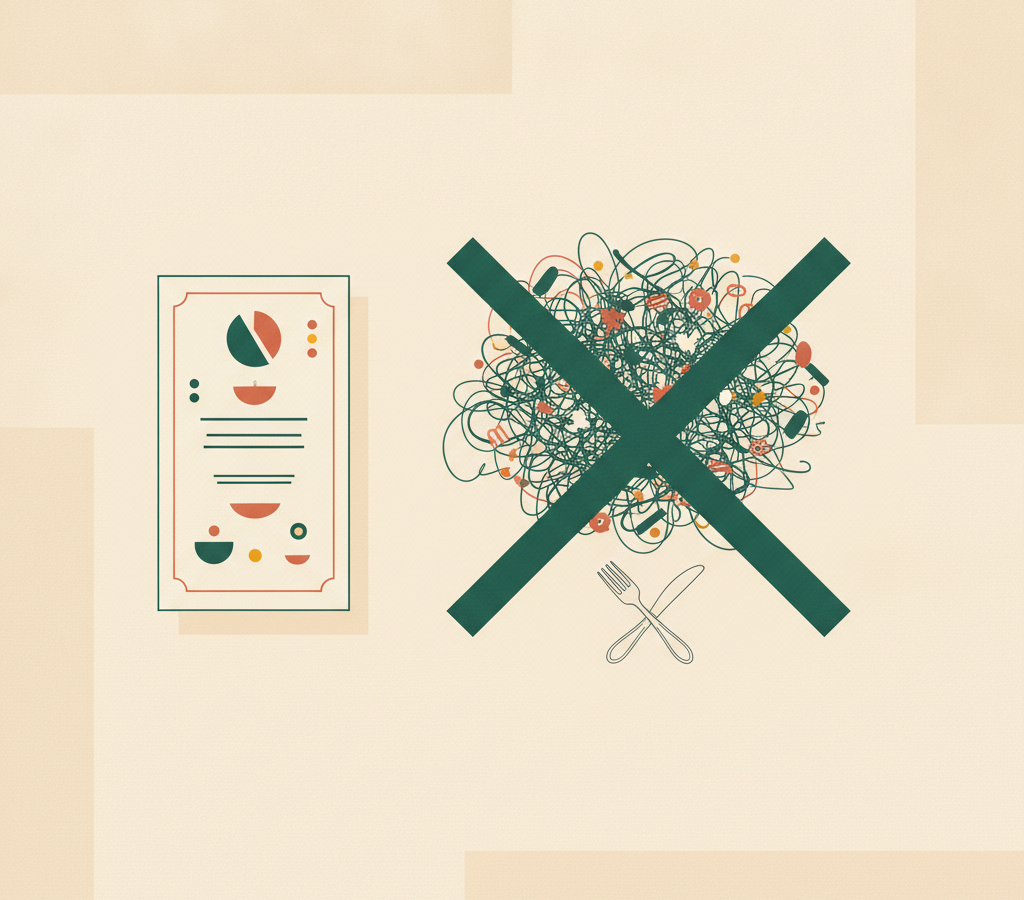
Restaurant menus are shrinking mainly because a shorter menu is cheaper and easier to run: it cuts food waste, simplifies labor, and lets kitchens buy fewer ingredients that cross more dishes. For diners, a smaller restaurant menu often signals a more focused, fresher, and better-executed kitchen — though it can also mask cost-cutting.
The Thirty-Page Menu Was Always a Lie
There used to be a particular kind of restaurant pride on display in the thick, plastic-sleeved menu — the one that ran to thirty pages and offered, without visible embarrassment, Peking duck alongside chicken marsala alongside a full page of appetizer salads. The implicit promise was generosity. You could have anything. The kitchen was for you.
That menu was always a fiction. What it actually promised was that most things on it would be cooked from frozen, stored for weeks, and executed by a line cook juggling fifteen wildly different preparations at once. The abundance was theatrical. The cooking, frequently, was not.
That fiction is getting harder to sustain. Over the past five years — and with accelerating force since 2022 — restaurants across price points have been cutting their menus down. The casual-dining chain that once listed forty-seven entrees now offers twenty. The neighborhood bistro that used to run a six-panel card has trimmed to a single sheet. Independent fine-dining rooms in many cities now offer a single tasting format, full stop. The era of the encyclopedic menu is not quite over, but it is clearly in retreat.
The forces driving this are mostly economic and operational. The upsides for diners are real and somewhat underappreciated. The trade-offs are genuine and worth naming honestly.
Why Menus Are Shrinking: The Unsexy Truth
The restaurant industry’s cost structure has been under severe pressure since at least 2021. Food costs — what operators pay for ingredients — rose sharply as supply chains buckled during the pandemic and did not fully recover. The U.S. Bureau of Labor Statistics has tracked persistent food-at-home and food-away-from-home inflation through 2022 and 2023, with certain categories, particularly proteins and oils, experiencing spikes that made purchasing planning extremely difficult. A restaurant that locked in a menu price in January could be badly underwater on that dish by April.
Labor costs have compounded the problem. The National Restaurant Association has reported that staffing remains among the top operational challenges for operators, with wages rising and experienced kitchen staff increasingly difficult to retain. A shorter menu is not just a response to ingredient cost — it is a direct labor-efficiency tool. Fewer dishes mean fewer prep tasks, simpler mise en place, and a line that can be staffed with fewer hands or less experienced cooks without the quality falling apart.
Waste reduction is the third economic driver, and it is probably the most straightforward. Every dish on a menu requires ingredients held in inventory. The longer the menu, the more SKUs a kitchen is managing, and the more that spoils before it is used. This is not a marginal concern: the National Restaurant Association has estimated that food waste accounts for a meaningful share of restaurant operating costs. A tightly focused menu, where most ingredients cross multiple dishes, is simply more efficient to run — and more profitable.
Finally, there is the rise of digital and QR menus, which accelerated dramatically during the pandemic as a contactless substitute for physical menus and has stuck. A QR code is not just an infection-control measure; it is an update mechanism. Restaurants can 86 a dish in real time, rotate in seasonal specials, and adjust pricing without reprinting anything. This frictionlessness has made dynamic, shorter menus more practical than they were when every change required a trip to the printer.
A shorter menu is also a story about identity — the one we unpack in why “authentic” restaurants are a marketing idea.
What Research Tells Us About Too Many Choices
The business case for menu reduction is well-established in hospitality management, but there is a parallel argument from cognitive psychology that gets cited less often in food writing and deserves more attention.
In a now-famous 2000 study published in the Journal of Personality and Social Psychology, researchers Sheena Iyengar and Mark Lepper set up a jam-tasting booth at a grocery store. When the booth offered 24 varieties of jam, more people stopped — but only 3 percent bought. When it offered 6 varieties, fewer people stopped, but 30 percent bought. The finding entered the popular lexicon as the paradox of choice: more options can produce less satisfaction, more decision paralysis, and ultimately less action.
Applied to restaurant menus, the implication is not that diners want fewer choices in any absolute sense — it is that an excess of options can generate anxiety rather than pleasure. The experience of scanning a forty-eight-item menu and trying to feel confident about your selection is a recognizable mild misery. You worry you will pick the wrong thing. You ask your dining companion what they are getting. You default to the thing you always order. The expansive menu, paradoxically, can make the meal feel smaller before it has even started.
A shorter menu curated by a kitchen with a clear point of view offers something different: permission to trust. When a restaurant offers eight dishes and each one is obviously considered, the implicit message is that the kitchen knows what it is doing and has staked its reputation on these specific preparations. That is a form of hospitality, not deprivation.
A Confident Kitchen Edits Itself
The best chefs have understood this for a long time. The shortest menus in the world are at the most serious restaurants: two dozen courses at a kaiseki counter, a fixed five courses at a Michelin-starred room, a daily changing menu of six dishes chalked on a board at a neighborhood bistro running on whatever the farmer brought that morning. The constraint is not poverty of imagination — it is the opposite. It is the confidence to commit.
What has changed is that this logic has migrated down-market, partly by economic necessity and partly by cultural diffusion. The same chain restaurants that once competed on menu breadth — treating the sheer number of options as a selling point — have begun to recognize that their customers do not actually want fifty-seven items. They want six good ones, reliably executed. Darden Restaurants, which operates Olive Garden and other large casual-dining brands, has discussed menu simplification publicly as a strategy for both operational efficiency and guest experience. It is not the only major operator to have moved in this direction.
There is also a fresh-ingredient argument that is related but distinct. A short menu can rotate seasonally in ways that a long one cannot. If a kitchen is running fifteen dishes, it can swap out two or three when strawberries arrive or when the local tomato is worth celebrating. If it is running forty-five, seasonal adjustment becomes almost impossible — too much reprinting, too much retraining, too much mise en place to reconfigure. The shorter menu is more alive. It responds to the world outside the kitchen door in ways that the exhaustive laminated document almost never can.
Are smaller restaurant menus actually better for diners?
Smaller restaurant menus are usually better for diners because they concentrate a kitchen’s attention on fewer dishes, which tends to improve freshness, consistency, and execution. When a kitchen runs ten dishes instead of fifty, each one is cooked more often, prepped from ingredients that turn over quickly, and refined by repetition. Cooks develop muscle memory for a tight repertoire in a way that is impossible across an encyclopedic card. The result, in a well-run room, is food that arrives more reliably and tastes fresher, because less of it has been sitting frozen in anticipation of an order that may not come for days.
The benefit is not automatic, though. A smaller restaurant menu helps diners only when the reduction reflects focus rather than pure cost-cutting. The way to tell them apart is texture: a genuinely improved short menu changes with the seasons, describes its ingredients with specificity, and shows evidence of a point of view. A hollowed-out short menu, by contrast, has simply had its labor-intensive dishes removed and left the survivors unchanged. Both look similar on the page, but they eat very differently.
Do shorter restaurant menus mean higher prices?
Shorter menus do not automatically raise prices, but menu reduction and price increases often arrive together, and diners are right to distinguish focus from a margin play. A kitchen that trims its offering to cut waste and labor can pass some of those savings along, or at least hold prices steady while improving quality. That is the honest version of the trend, and it genuinely benefits the diner. But the same vocabulary of “curation” and “focus” can also be used to justify charging more for less — fewer dishes, higher prices, no corresponding improvement in ingredients or execution.
Reading the difference comes down to what changes alongside the shrinking menu. If prices rise while the remaining dishes get demonstrably better sourcing, more seasonal rotation, or more careful preparation, the increase reflects real value. If prices rise while the surviving dishes are exactly what they were a year ago — just with the complicated, generous items quietly removed — that is price-adjusted shrinkage dressed in the language of restraint. Skepticism is warranted when the curation narrative and a noticeably higher bill appear at the same moment with nothing on the plate to justify it.
The Trade-Offs Are Real
None of this means the trend is without costs. The most obvious one is that dishes disappear. The thing you loved — the specific preparation you returned to, the dish you brought out-of-town visitors to try — gets cut because it was operationally complex or because the kitchen moved on. This is a genuine loss, and it is worth acknowledging rather than papering over with efficiency rhetoric.
Behind every menu decision sits a spreadsheet, and the real cost of running a small business explains most of it.
There is also the question of whether shorter menus are sometimes a form of price-adjusted shrinkage rather than quality improvement. Menu reduction that coincides with price increases on remaining items, without a corresponding improvement in execution or ingredients, is not a gift to the diner — it is a margin play dressed in the language of focus. The signal of a confident kitchen is real; the same language can also be used to justify doing less for more. Diners are right to be skeptical of the vocabulary of curation when it arrives simultaneously with a bill that is noticeably higher than last year.
Dietary accommodation becomes harder too. A restaurant that once carried something for every allergy, preference, and restriction by virtue of sheer volume may now offer fewer exits for the diner with constraints. This is a practical problem that some kitchens handle well — by building flexibility into fewer dishes — and others do not.
Reading the Room
The useful heuristic, in the end, is not the length of the menu but what a short menu tells you about the kitchen’s relationship to its own cooking. A short menu at a restaurant that changes it regularly, sources visibly, and prices fairly is an invitation. A short menu at a restaurant that has been cutting costs for two years and has eliminated everything that was labor-intensive is a different thing entirely — though it may look identical on the page.
The way to tell the difference is usually context and texture: Is there a specials board? Does the server know where the fish came from? Has the menu changed since last month? Does the kitchen seem to have an opinion about what it is cooking, or is it simply executing the minimum viable offering?
The shrinking menu is, on balance, a good development for anyone who eats in restaurants — but it is not automatically good. It is a tool that a kitchen either uses well or does not. What it has done, usefully, is made the menu itself a more legible signal of what kind of place you are in. A thoughtful short menu is a kitchen telling you something true about itself. That is more than most thirty-page menus ever managed.
Frequently asked questions
Why are restaurant menus shrinking?
Mostly for economic and operational reasons. A shorter menu reduces food waste, lowers labor demands, and lets a kitchen buy fewer ingredients that appear across multiple dishes. Rising food and labor costs since 2021, plus the flexibility of digital and QR menus, have accelerated the trend.
Are smaller restaurant menus better?
Usually yes, when the reduction reflects focus. Fewer dishes are cooked more often and prepped from faster-turning ingredients, which tends to improve freshness and consistency. The benefit disappears if the menu was simply hollowed out to cut costs.
Do shorter menus mean the food is fresher?
Often. A tight menu lets ingredients cross several dishes and turn over quickly, so less is held frozen or in long storage. Short menus can also rotate with the seasons in ways a large menu cannot.
Does a smaller menu mean I am paying more for less?
Not necessarily, but it can. Watch what changes alongside the reduction: better sourcing and more seasonal rotation justify a higher price, while removing complex dishes and raising prices with no change to the survivors is a margin play.
Why do the best restaurants have such short menus?
Because a tight menu is a mark of confidence and control. Serious kitchens — from kaiseki counters to Michelin rooms to neighborhood bistros — limit their offering so they can commit fully to each dish rather than spreading effort thin.
Do shorter menus make dietary accommodation harder?
Sometimes. A large menu once covered many allergies and preferences by sheer volume. A short menu offers fewer built-in options, though skilled kitchens compensate by building flexibility into the dishes they do serve.
How can I tell a focused short menu from a cost-cut one?
Look for a specials board, seasonal changes, servers who know ingredient sourcing, and a menu that has clearly changed recently. A cost-cut menu tends to stay static, with the generous or labor-intensive dishes quietly gone.
Miguel Ortiz covers culture, food, and travel for Fullimedia. For more on how the food industry talks about itself — and who that language is really for — see our Culture section. Our weekly newsletter includes a food note most Thursdays.