Vinyl records outsell CDs because buyers are paying for ownership, ritual, collectibility, and direct artist support — things streaming does not provide. The vinyl revival is driven less by audio quality than by a desire to own music as a tangible object in an era when everything else is rented access.
The compact disc was supposed to be the permanent format. It was smaller than a record, more durable than a cassette, and — the sales pitch went — essentially perfect. For roughly two decades, from the mid-1980s through the mid-2000s, it was. Then streaming arrived, the CD collapsed, and almost no one mourned it publicly. What no one quite expected was that the format left behind — the twelve-inch vinyl record, bulky and fragile and expensive to press — would stage one of the stranger commercial reversals in the recent history of media.
The Numbers
According to the Recording Industry Association of America (RIAA), vinyl LP revenue in the United States surpassed CD revenue for the first time since the 1980s in 2020, and has maintained that lead every year since. The RIAA’s annual reports track wholesale revenues by format; in 2023, vinyl generated approximately $1.4 billion in U.S. revenue compared to roughly $560 million for CDs. These are not enormous sums relative to the $15.9 billion total recorded-music market that year, in which paid streaming subscriptions account for the dominant share. But the relationship between the two physical formats is no longer close.
Unit volumes tell a complementary story. The RIAA counted approximately 49.6 million vinyl LPs shipped in 2023, versus about 37.6 million CDs — and vinyl’s average retail price is considerably higher, which is why the revenue gap is wider than the unit gap. A new LP from a major artist routinely retails between $25 and $35. A new CD, where it exists at all, may sell for $12 to $15. The format that costs more is the one that is growing.
Globally, the International Federation of the Phonographic Industry (IFPI) has tracked similar trends in its annual Global Music Report. The IFPI’s 2024 edition noted that physical format revenues — dominated by vinyl — remained a meaningful contributor to total industry income in several key markets including the United States, Japan, Germany, and the United Kingdom, even as those markets are simultaneously among the world’s largest streaming markets. Japan is a notable outlier: CD sales there remain substantial, partly due to idol-group release strategies that bundle CDs with concert tickets and fan experiences. But the U.S. trajectory is unambiguous.
Why are vinyl records so popular again?
Vinyl records are popular again because buyers want to own music as a physical object rather than rent access to it, and because records offer ritual, collectibility, and a direct way to support artists that streaming cannot match. The revival is not primarily nostalgia: a substantial share of vinyl buyers are under 35 and never grew up with the format. What draws them is a set of wants that streaming, for all its convenience, leaves unmet — the sense of permanence that comes with an object you can hold, shelve, and keep regardless of any licensing deal.
Streaming solved the problem of access comprehensively; more than 100 million tracks sit behind a single monthly fee. What it did not solve is the problem of value. When everything is available always, the experience of choosing and owning a particular thing acquires a significance that pure access cannot provide. Vinyl records answer that need directly, which is why the format that costs more, takes up shelf space, and requires special equipment is the one growing fastest. The following sections separate the distinct forces at work, because collapsing them into a single nostalgic story misses what is actually happening.
Ownership versus access
Streaming is a license, not a purchase. When a label’s deal with a streaming platform expires, or when a platform shuts down, or when an artist disputes royalties and pulls their catalog, the music disappears from a subscriber’s queue. The 2023 closure of Bandcamp’s editorial operation, followed by successive ownership changes at the platform, reminded many listeners how contingent their access to certain recordings actually was. Vinyl buyers are purchasing an object. The ownership is real and unconditional in a way that a subscription is not. This is not anti-technology sentiment; it is a straightforward assessment of what different products actually provide.
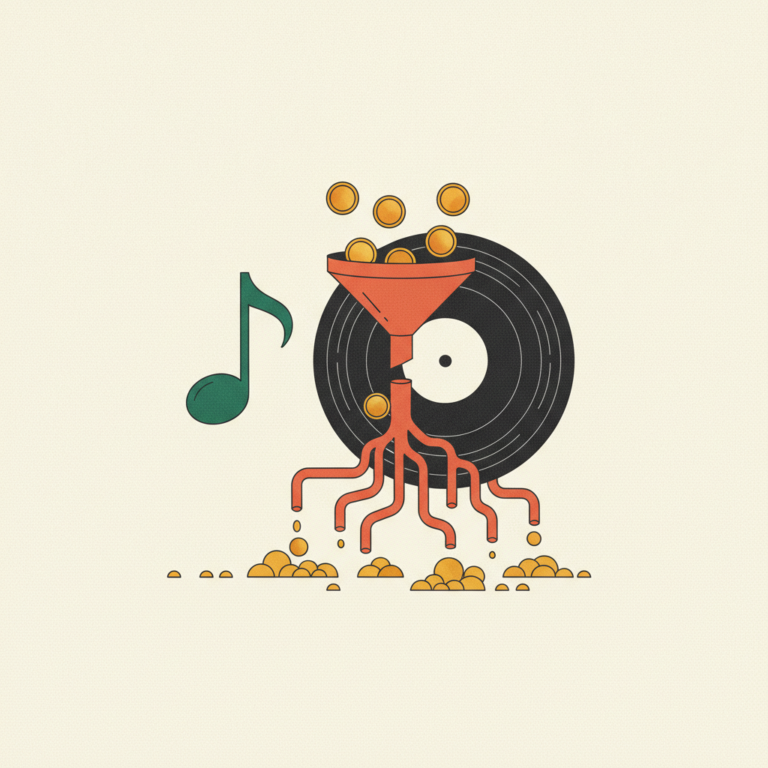
To see why artists lean so hard on physical formats, follow the money in who actually gets paid when a song is a hit.
Ritual and attention
The friction of vinyl — the act of choosing a record, placing it on the platter, lowering the stylus — is for many buyers a feature rather than a defect. Streaming’s infinite, algorithmic scroll has produced a listening culture that is ambient and often inattentive. A record demands a different posture. It has a fixed running time. It has a side structure that reflects compositional decisions. It rewards reading liner notes. Sociological research on music consumption, including work cited by the IFPI, has consistently found that consumers who invest in physical formats report higher levels of engagement with individual albums and greater satisfaction with the listening experience. The format shapes the attention, and the attention shapes the perceived value.
Collectibility and the object economy
Vinyl has developed a secondary market that CDs largely never did. Limited pressings, colored variants, signed editions, and indie-store exclusives have turned record-buying into something adjacent to collecting art prints or sneakers. Record Store Day, which began in 2008, has institutionalized the limited-edition release as an annual commercial event; its 2024 edition again drew queues outside independent shops in cities across the United States and Europe. Major labels now produce elaborate box sets with extensive packaging precisely because the format can justify the premium in a way that a CD jewel case never quite managed aesthetically. This is not purely a nostalgia market — a substantial share of vinyl buyers are under 35 and did not grow up with the format as their primary listening medium.
Artist support as direct transaction
The economics of streaming have made artist compensation a persistent source of public controversy. Royalty rates vary considerably depending on deal structures, but widely cited analyses — including reporting by Music Business Worldwide and data filed in various licensing proceedings — suggest that a stream on a major platform generates a fraction of a cent for the rights holder, with the artist’s share of that fraction depending on their recording contract. For independent artists, streaming can generate meaningful income at scale, but “at scale” means tens or hundreds of millions of streams. For working musicians who do not operate at that volume, a vinyl sale at $25 to $30 wholesale, where the artist retains a negotiated royalty, can represent more income than several thousand streams.
Many vinyl buyers are explicitly aware of this arithmetic. Bandcamp, before its turbulent ownership changes, cultivated a purchasing culture explicitly framed around direct artist support. That ethos has migrated, at least partly, to record stores and artist webstores. Buying a record is a legible transaction in a way that adding a song to a playlist is not.
Do vinyl records actually sound better than CDs or streaming?
Vinyl does not measurably sound better than CDs or lossless streaming — digital formats have wider dynamic range and lower noise — but many listeners prefer vinyl’s warmer, softer character, and the audio quality is not the main reason the format is reviving. By objective measures, a CD or a high-resolution stream reproduces the source recording more accurately than an LP, which introduces surface noise, wear over time, and physical limitations on bass and volume. The analog-versus-digital debate is real among audiophiles, but it is largely beside the point commercially.
What vinyl offers is a distinct sonic signature that some people genuinely like — a gentle roll-off and harmonic coloration often described as “warmth” — plus the experience of deliberate, full-album listening that the format encourages. Crucially, though, the mastering matters more than the medium: a record cut from a well-made master can sound superb, while the same album streamed from a poor master can sound worse, and vice versa. Buyers are not, for the most part, paying $30 for measurably superior fidelity. They are paying for the object, the ritual, and the ownership, with the sound character as a bonus rather than the driver.
Is it worth buying used vinyl records?
Buying used vinyl records is often worth it: secondhand records are cheaper than new pressings, out-of-print titles are frequently available only used, and a record in good condition plays essentially as well as a new one. The used market is where vinyl’s collectible economy is most active, and it rewards attention. Much of the catalog worth owning was never repressed, so the only way to obtain many albums is through crate-digging, discount bins, and online resale — where prices for common titles can be a fraction of new-LP retail.
The main thing to check is condition. Records are graded on their sleeve and disc separately, and surface scratches, warps, and groove wear affect playback quality, so inspecting the disc or trusting a reputable seller’s grading matters. A well-kept used record cleaned before play can sound indistinguishable from new, while a scuffed bargain-bin copy may crackle throughout. For most buyers, the used market offers the best value in vinyl — lower prices, deeper selection, and the same durable ownership that draws people to the format in the first place.
What It Reveals About Listener Psychology
Taken together, the vinyl resurgence is less about audio quality debates — the analog-versus-digital argument is real but mostly beside the point commercially — and more about a specific set of wants that streaming does not satisfy. Listeners who buy records are purchasing a relationship to music that is tangible, ownable, and bounded. The record is a complete object. It has edges. It fits on a shelf next to other objects that say something about who you are. It is not an entry in a database.
This is not an irrational preference, and it is worth resisting the framing that treats it as mere sentiment or technophobia. Streaming has solved the problem of access comprehensively. What it has not solved — and what vinyl buyers are paying to address — is the problem of value. When everything is available always, the experience of choosing and owning a particular thing acquires significance that pure access cannot provide.
The parallel to other media is instructive. Physical book sales have remained resilient through the e-book era; print book revenues in the United States have consistently outpaced digital editions in annual reporting from the Association of American Publishers. Theatrical cinema attendance collapsed during the pandemic but recovered more quickly than many analysts predicted, because the out-of-home experience offers something qualitatively different from streaming the same film at home. In each case, the convenient format won the access war and lost the attention war, at least partially.
The Limits of the Revival
None of this should be overstated. Vinyl’s $1.4 billion in annual U.S. revenue is roughly nine percent of the total recorded-music market. Streaming is not going anywhere, and the economics of music discovery are now structured entirely around algorithmic platforms that vinyl cannot touch. The artists who sell the most vinyl — Taylor Swift, Olivia Rodrigo, Harry Styles, legacy acts with devoted fan bases — are also among the most-streamed artists in the world. The format revival is a layer on top of the streaming economy, not an alternative to it.
Supply constraints have also been a recurring problem. The global network of vinyl pressing plants contracted severely during the CD era and has struggled to expand quickly enough to meet renewed demand. Lead times of six months or more between a mastering session and a finished LP have frustrated independent labels, and pressing costs have risen substantially. The format’s growth may be partly supply-constrained, meaning the demand picture could be even stronger than current sales figures suggest — or it could mean that the market is approaching a ceiling set by production capacity.
What the sustained sales trajectory does establish is that the revival is not a fad. Vinyl has now outsold CDs in the United States for several consecutive years across different market conditions, interest-rate environments, and consumer sentiment cycles. The preference is durable. Fullimedia has previously examined the shifting economics of the entertainment industry as physical and digital formats compete for both consumer attention and artist income; the vinyl story is one of the cleaner illustrations of what listeners will pay for when access alone is not enough.
For musicians, the implication is worth noting: the formats that generate the clearest economic relationship between artist and listener — the ones where a consumer hands over money and receives an object — still command meaningful premiums. That premium is not irrational. It is, in fact, an accurate price signal about what music is worth when it is treated as a thing rather than a service. If you want to follow reporting on the business of culture and music, Fullimedia’s editorial briefing covers it regularly.
Frequently asked questions
Why are vinyl records so popular again?
Because buyers want to own music as a tangible object rather than rent access, and because records offer ritual, collectibility, and a direct way to support artists. The revival is driven more by these wants than by nostalgia or audio quality.
Why do vinyl records outsell CDs?
Vinyl has surpassed CD revenue in the United States every year since 2020, helped by higher retail prices ($25–$35 per LP versus $12–$15 per CD) and a collectible culture of limited pressings and exclusives that CDs never developed.
Do vinyl records sound better than streaming or CDs?
Not by objective measures — digital formats have wider dynamic range and lower noise. Many listeners prefer vinyl’s warmer character, but the mastering matters more than the medium, and sound quality is not the main reason for the revival.
Is buying vinyl a good way to support artists?
Yes. A vinyl sale where the artist retains a negotiated royalty can represent more income than several thousand streams, which pay only a fraction of a cent each. Buying from record stores and artist webstores makes the transaction especially direct.
Is it worth buying used vinyl records?
Often yes. Used records are cheaper than new pressings, many out-of-print titles are available only secondhand, and a well-kept record in good condition plays essentially as well as new. Check the disc’s condition or the seller’s grading before buying.
Are young people actually buying vinyl?
Yes. A substantial share of vinyl buyers are under 35 and did not grow up with the format as their primary listening medium, which is one reason the revival is considered durable rather than pure nostalgia.
Will vinyl replace streaming?
No. Vinyl is roughly nine percent of the U.S. recorded-music market and sits as a layer on top of the streaming economy, not an alternative to it. The biggest vinyl sellers are also among the most-streamed artists in the world.