
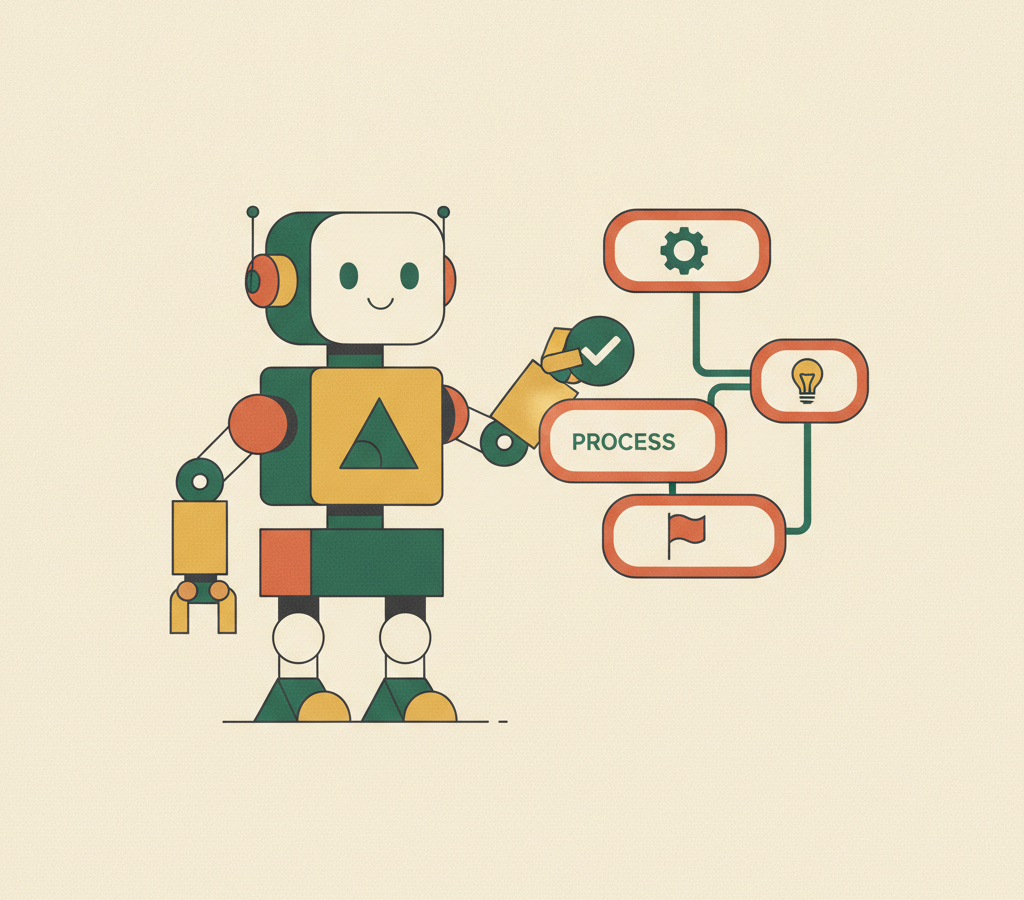
Agentic AI is a language model wired to take actions and loop — calling tools, checking the result, and deciding the next step — so it can complete a multi-step task instead of just answering a question.
Walk through any technology conference in 2026 and you will hear the same word over and over: agentic. Every product is now an “AI agent.” Most of the people using the term cannot tell you what it means, and a good number of the companies using it are hoping you won’t ask. So let’s ask.
An AI agent, stripped of the marketing, is a language model that has been wired up to take actions — not just to answer a question, but to call tools, search the web, run code, file a ticket, or send a message — and to loop: act, observe the result, and decide what to do next. That loop is the whole idea. A chatbot answers; an agent tries to get something done.
What an agent actually is
The simplest useful definition has three parts. There is a model that can reason about a goal. There are tools it is allowed to use — a calendar, a code runner, a database, a browser. And there is a loop that lets it use those tools repeatedly until it decides the job is finished. Take away the tools and you have a chatbot. Take away the loop and you have autocomplete. Put all three together and you have something that can, in the right conditions, complete a multi-step task on your behalf.
“In the right conditions” is doing enormous work in that sentence, and it is exactly the part the demos skip.
Where those agents actually run matters as much as what they do — our look at what on-device AI means for your privacy covers the other half of this shift.
What is agentic AI in simple terms?
In simple terms, agentic AI is software that can pursue a goal by itself, taking several steps and using outside tools to get there, rather than producing a single reply and stopping. The clearest way to picture it is the difference between an assistant who answers a question and an assistant who handles an errand. Ask an ordinary chatbot “what’s a good flight to Lisbon next month?” and it will describe options. An agent, given the same goal and the right permissions, would search live prices, compare them against your calendar, hold a fare, and report back — pausing where it needs a decision from you.
The key mental shift is that an agent is defined by what it can do, not by how fluent it sounds. Fluency is the easy part now. The hard part — and the part worth evaluating — is whether the system can string actions together reliably, notice when a step failed, and recover without making things worse. When someone asks what agentic AI is, the honest short answer is: a model plus tools plus a loop, aimed at a task. Everything else is detail layered on that skeleton.
What is agentic AI vs generative AI?
Generative AI produces content — text, images, code, audio — in response to a prompt; agentic AI uses that same generative core to decide on and carry out actions in the world. Generative AI answers; agentic AI acts. The distinction matters because the two are constantly conflated in marketing, and the risks are not the same.
A generative system’s output is words or pixels on a screen. If it is wrong, you read something inaccurate and move on. An agentic system’s output can be a sent email, a modified file, a placed order, or a closed ticket. If it is wrong, the consequence is out in the world before you have read anything. Generative AI is the engine; agentic AI is the engine bolted to a steering wheel, a throttle, and a set of hands. That is why a capable generative model can be perfectly safe as a writing tool and genuinely hazardous the moment you give it the ability to act unattended.
Put another way: every agentic system contains a generative model, but not every generative model is agentic. The word “agentic” is a claim about autonomy and action, not about how good the underlying writing is.
Where agents genuinely help today
The honest answer is: narrow, well-scoped, verifiable tasks. The places agents earn their keep in 2026 are the ones where the goal is clear, the steps are bounded, and a wrong answer is easy to catch.
Research assistants that read twenty sources and hand you a sourced summary work well, because you can check the sources. Coding agents that write a function, run the tests, and fix what fails work well, because the tests are the verifier. Data-cleanup agents that take a messy spreadsheet and normalize it work well, because you can spot-check the output. Scheduling, drafting, triage, repetitive back-office work — the unglamorous middle of knowledge work — is where the real value is hiding.
What is an example of agentic AI in practice?
A good example of agentic AI is a coding assistant that reads a bug report, edits the code, runs the test suite, sees which tests still fail, and fixes them in a loop until they pass — using the tests themselves as the check on its own work. That single example contains the whole pattern: a goal, tools (the editor and the test runner), a loop, and — crucially — a built-in verifier.
Other examples that hold up in real use share the same shape. A research agent that gathers sources, extracts the relevant passages, and drafts a summary with citations you can click through. A customer-support triage agent that reads an incoming message, categorizes it, pulls the relevant account details, and drafts a reply for a human to approve. A data agent that ingests a chaotic export, standardizes the columns, flags rows it could not classify, and hands you a clean file plus a list of exceptions.
Notice what the strong examples have in common. The task is bounded, the output is checkable, and there is a natural place for a human to catch a mistake before it matters. The weak examples — “an agent that runs your entire business” — fail precisely because they remove all three of those properties at once.
Where they still break
Agents fall apart on long, ambiguous, high-stakes tasks — the exact tasks the splashy demos love to show. The failure modes are predictable once you know them. They lose the thread on tasks with many steps, confidently doing the wrong thing rather than stopping to ask. They cannot reliably tell when they are stuck. And they have no instinct for when a mistake is expensive, which is precisely when you need that instinct most.
This is not a reason to dismiss them. It is a reason to scope them. An agent that can act in the world without a human checking the consequential steps is not a productivity tool; it is a liability with good grammar.
There is also a compounding-error problem that gets worse the longer the loop runs. Each step in an agent’s chain has some chance of going slightly wrong, and later steps build on the output of earlier ones. A small misreading in step two becomes a confident wrong conclusion by step nine, because nothing in between flagged it. Humans catch this kind of drift because we hold a running sense of whether things still make sense; current agents largely do not. The practical implication is that shorter chains with more frequent checkpoints beat long autonomous runs almost every time.
Is agentic AI safe? Understanding agentic AI security
Agentic AI is only as safe as the permissions and checkpoints you put around it: the security question is not whether the model is trustworthy in the abstract, but what it can touch and what happens when it is wrong. Because agents take actions, they widen the attack surface in ways a chatbot never could.
Two risks deserve specific attention. The first is over-broad permissions: an agent given standing access to your email, files, or payment methods can cause real damage from a single bad decision, and it will do so quickly and quietly. The principle to apply is least privilege — grant the narrowest access the task actually requires, and nothing more. The second is prompt injection, where malicious instructions hidden in a web page, document, or email that the agent reads get treated as commands. An agent that browses the open web on your behalf is reading untrusted content, and that content may be written specifically to hijack it.
The defenses are unglamorous but effective: keep a human in the loop before anything irreversible, scope credentials tightly, log what the agent does so you can audit it, and treat everything the agent reads from the outside world as data rather than instruction. None of this is exotic security engineering — it is the same discipline you would apply to any system that can act, applied to one that also improvises.
Agents acting on your behalf also raise the stakes for account security, which is where passkeys and the slow death of the password come in.
How to evaluate an “agentic” product
Treat “agentic” as a spectrum, not a switch, and ask three questions of any product that claims it. What, specifically, can the agent do — which tools, which actions, what is off-limits? What happens when it is wrong — does it fail loudly, ask for help, or quietly do damage? And where is the human — is there a review step before anything irreversible, or are you trusting the loop with your calendar, your code, or your money?
A good agentic product has clear answers. A weak one answers in adjectives.
There is a fourth question worth adding for anything you are paying for: how is success measured, and can you see it? A serious agentic product exposes its work — the steps it took, the sources it used, the actions it queued for approval — so you can judge the result rather than trust it on faith. A product that hides the loop behind a single confident answer is asking you to do the one thing this technology has not yet earned: assume it got everything in between right.
The bottom line
Agentic AI is real, and it is genuinely useful — for bounded tasks, with verification, and with a human in the loop on anything that matters. It is not, in 2026, a competent autonomous colleague, and the companies implying otherwise are selling the demo, not the product. Used with that clarity, an agent can quietly take a real slice of busywork off your week. Used on faith, it will eventually cost you an afternoon cleaning up after it. The difference is entirely in how narrowly you point it.
Frequently asked questions
What is agentic AI in one sentence?
Agentic AI is a language model connected to tools and run in a loop, so it can take actions, observe the results, and decide its next step until a multi-step task is finished. Unlike a chatbot, which produces a single answer, an agent is built to actually get something done on your behalf within the permissions you grant it.
What is the difference between agentic AI and generative AI?
Generative AI creates content — text, images, or code — in response to a prompt and then stops. Agentic AI uses a generative model as its engine but adds tools and a decision loop so it can act in the world: sending messages, running code, or updating records. In short, generative AI answers a question while agentic AI carries out a task.
What is an example of agentic AI?
A common example is a coding agent that reads a bug report, edits the code, runs the test suite, and keeps fixing failures in a loop until the tests pass. Other examples include research agents that gather and summarize sources with citations, and support agents that triage incoming messages and draft replies for a human to approve.
Is agentic AI safe to use?
Agentic AI is as safe as the guardrails around it. Because agents take real actions, the risks are broad permissions and prompt injection from untrusted content. Grant the narrowest access a task needs, keep a human approving anything irreversible, and log the agent’s actions. With those controls, agents are useful; without them, they are a liability.
What is agentic AI used for in business?
In business, agentic AI is most valuable for bounded, repetitive, checkable work: triaging support tickets, cleaning and normalizing data, drafting routine documents, scheduling, and running research. The best results come from narrow tasks where the output can be verified and a human reviews anything consequential before it takes effect.
How is an AI agent different from a chatbot?
A chatbot responds to a message and waits for the next one. An AI agent is given a goal and works toward it over multiple steps, using tools and its own observations to decide what to do next. The defining difference is action and iteration: an agent can do things and adjust, where a chatbot only replies.
Can agentic AI replace human workers?
Not in 2026. Current agents handle narrow, well-scoped tasks reliably but fail on long, ambiguous, high-stakes work, and they lack judgment about when a mistake is expensive. They are best understood as tools that remove specific slices of busywork under human supervision, not as autonomous replacements for people.
What should I look for in an agentic AI product?
Ask what exactly the agent can do, what happens when it is wrong, where the human review step sits, and whether you can see the work it did. Strong products answer specifically and expose their steps, sources, and queued actions. Weak ones answer in adjectives and hide the loop behind a single confident result.